Shopping Cart


- New
Instruments for Geophysics and Seismology

Professional software for 3D interpretation of electrical tomography data by resistivity and induced polarization.
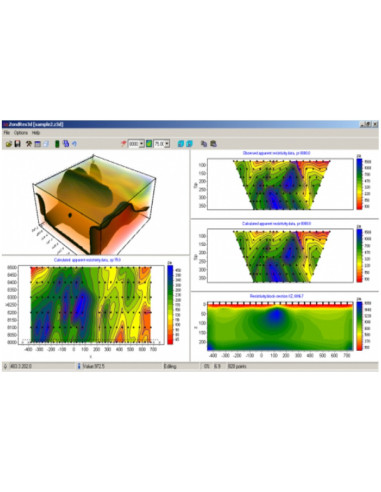
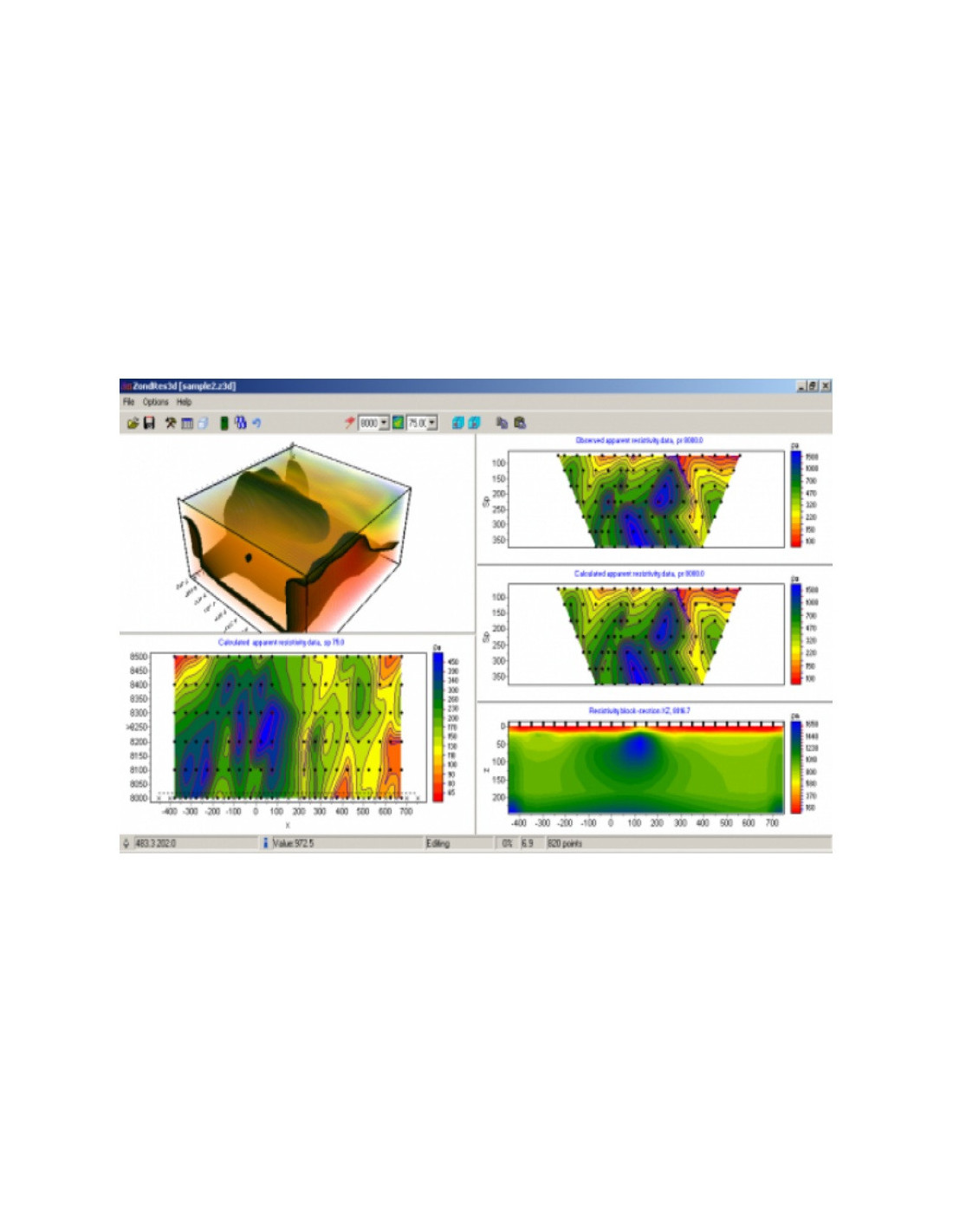
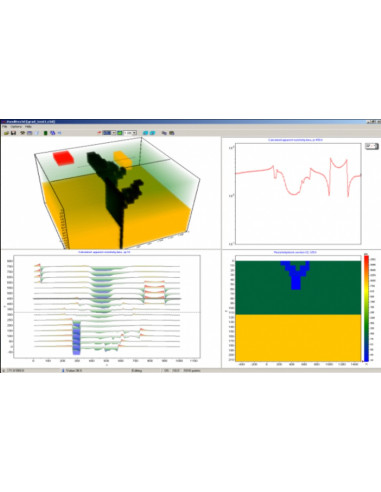
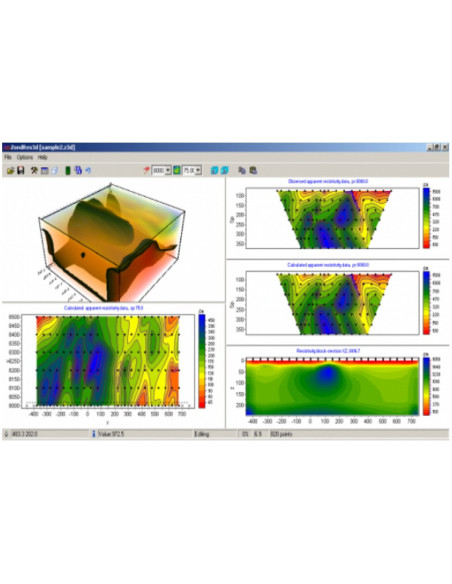
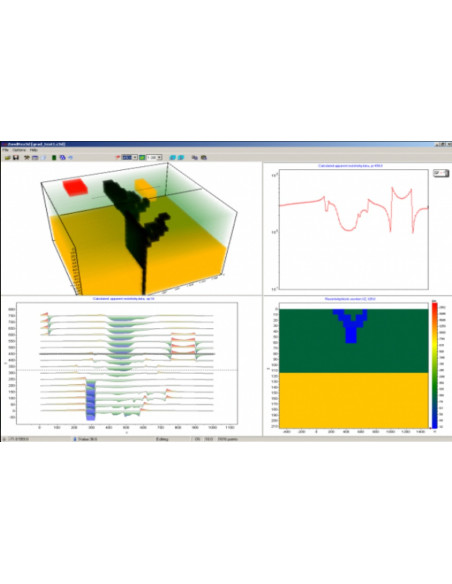
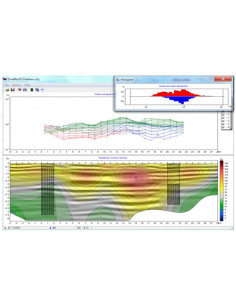
ZondRes3d program is designed for three-dimensional interpretation of electrical tomography resistivity and induced polarization data in land, cross-borehole and marine variants.
Electrical tomography is a complete technique including the field observation method and the technology for processing and interpreting field data. Its distinctive feature is the repeated reuse of the same electrode positions fixed on site, both as source and receiver.
This approach makes it possible to work with modern high-performance instruments while also applying effective modeling and inversion algorithms. Two-dimensional and three-dimensional models are used for the interpretation of electrical tomography data, significantly extending the range of problems that can be solved compared with classic horizontal-layered cases.
Resolution, and therefore interpretation quality, is closely connected with the number and density of measurements on one site. Their number usually reaches the first thousand, which is why field measurement efficiency is of basic importance. Special equipment with programmed automatic switching of electrodes is used to achieve maximum efficiency in field work.
The technique of three-dimensional electrical tomography involves a special measurement method using a considerable number of switched electrodes and several electric prospecting cables, while the number of measurements may reach tens of thousands. In many cases, for three-dimensional interpretation it is enough to use the results of two-dimensional electrical tomography acquired on several parallel profile lines.
A feature of ZondRes3d is its high resource usage, connected with the specificity of solving large-dimension forward and inverse problems, which requires a powerful computer. Two methods are implemented for electric field calculation, the finite element method and the finite difference method. The finite difference method works approximately twice as fast, but it does not allow the use of topography.
ZondRes3d uses a simple and clear data format that makes it easy to combine various observation systems, including different topography setup variants and other additional information.
The program works with any electrode array types used in electrical prospecting, including two-, three- and four-electrode arrays, or combinations of them. Well-known data formats are also supported.
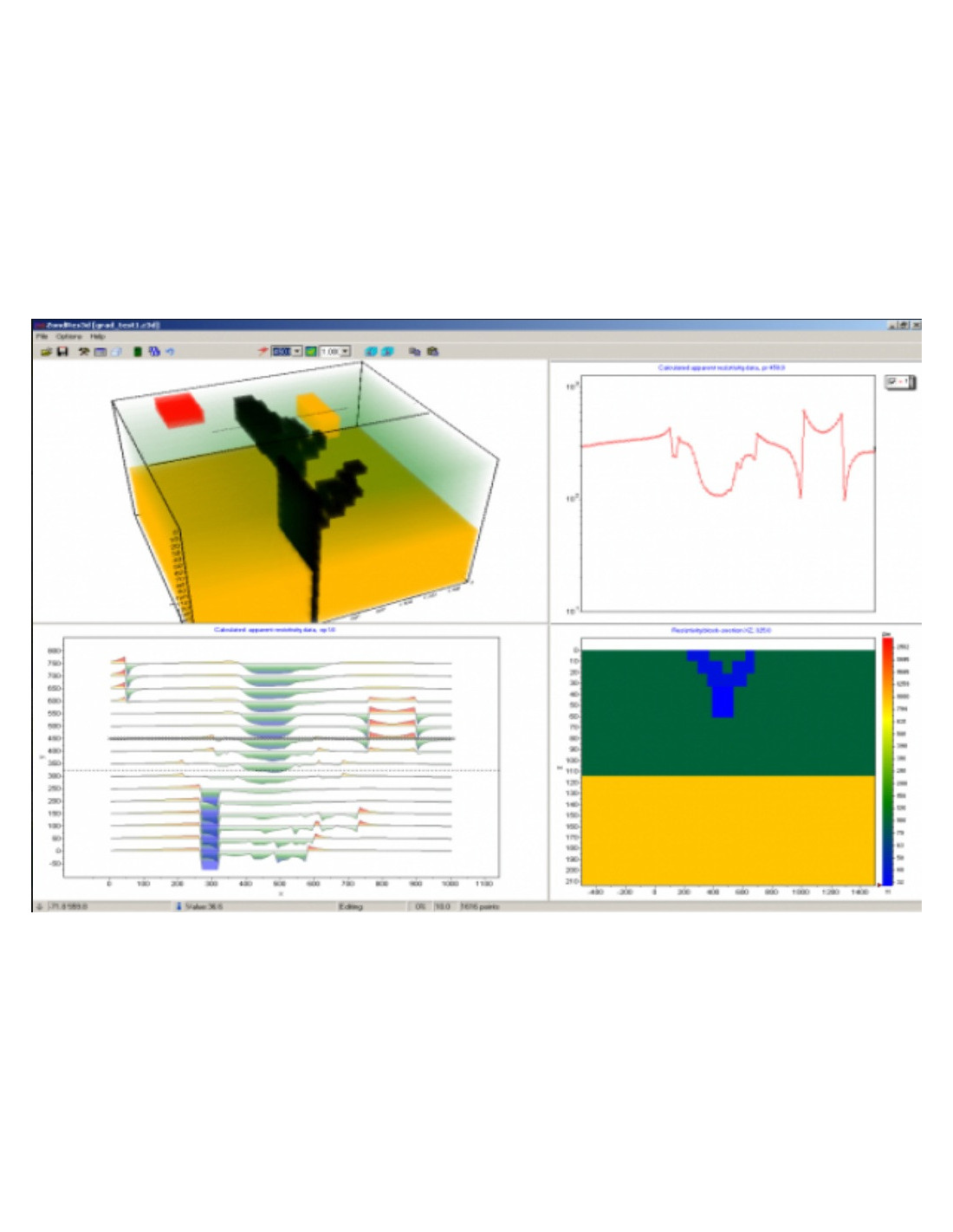
An important stage before field measurement is mathematical modeling of the geoelectric structure of the work site. Modeling makes it possible to estimate signal level and choose optimum parameters of the observation system for the geological problem to be solved. ZondRes3d offers a wide range of tools for mathematical modeling and sensitivity analysis of DC and induced polarization fields.
As the general task of the program is inversion of geoelectric section parameters, several inverse problem solution variants are implemented in ZondRes3d. The main ones are smoothing inversion, to obtain smooth distributions, and focusing inversion, to obtain piece-smoothed distributions of geoelectric parameters with depth.
You might also like