- Home
- Who We Are
- Products
-
Brands
-
Products by Measure
- Vibration Analyzers
- Peristaltic Pumps
- Airflow
- CO Carbon Monoxide
- Geiger counters
- Destiladores
- Spectrophotometry
- Sterilization
- Fluorescence
- GEOTECHNICS
- Soil Moisture
- Leaf area index
- Rain Gauge
- Meteorology
- Water Level
- O2 Oxygen
- pH
- Differential Pressure
- Radiation
- Salinity/Conductivity
- Telemetry
- Air Speed
- Relative Humidity
- Veterinary
- FUEL CELL HARDWARE
- Network Analyzers
- Calibrators
- WATER FLOW
- Color / Colorimeter
- Particle Counters
- Wind Direction
- Spectrometry
- Evapotranspiration
- Photosynthesis
- Cracks in Buildings
- Pipes Inspection
- Quantum Light
- Movement & GPS
- Diesel Level
- Oxígeno Disuelto DO
- Atmospheric Pressure
- Radon
- Sap/Sap Flow
- Temperature
- AIR QUALITY
- Ammonia
- Chlorophyll
- Conductivity in Soil
- Dendrometers
- Electrochemistry
- Spectroradiometry
- Pharmacy & Medicine
- GAS (ANALYZERS)
- Leaf Wetness
- Idc (DC Current)
- KW & KW/H
- PAR Light
- Nitrate
- Occupation and Time
- Particle Meters
- Soil Water Potential
- Pulses
- Flavor/Taste/Acidity
- Sodium
- Turbidity
- VOC
FCJJ-40 Renewable Energy Science Education Kit 2.0
Complete education kit for understanding how fuel-cell technology interacts with renewable energy sources to create a sustainable power grid. Includes hands-on activities, student materials and teacher guides.
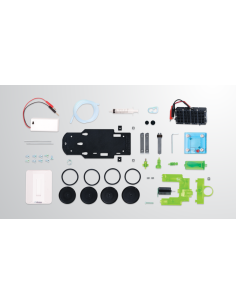
The Renewable Energy Science Education Kit 2.0 provides a complete understanding of how fuel-cell technology interacts with renewable energy sources to create an entirely sustainable power grid.
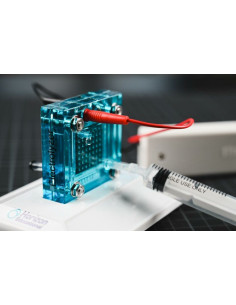
The kit enables experiments with solar power, wind energy, kinetic energy from a hand crank and the storage potential of a super capacitor. It includes a PEM hydrogen fuel cell, a salt-water fuel cell and a direct-ethanol fuel cell so students can compare different technologies.
Hands-on activities cover renewable energy sources, alternative fuels for transportation, clean power generation, energy storage and climate change. Complete project-based learning units address sustainable transportation and clean power generation.
Student and teacher materials support up to 20 class periods, including practical activities, teacher guides and student guides. A hydrogen source such as Hydrofill Pro is required to charge the supplied Hydrostik Pro cartridge.
- Experiments: 16
- Lesson time: 5–13 hours
- Teacher's guide: 100 pages
- Student's guide: 76 pages
- Curriculum content: 40 hours of classroom activities
- Technologies: PEM hydrogen, salt-water, direct-ethanol and reversible fuel cells
- Renewable sources: solar panel, wind turbine, temperature cell and hand crank
- Storage: super capacitor
- Level: middle and high school