

- Home
- Who We Are
- Products
-
Brands
-
Products by Measure
- Vibration Analyzers
- Peristaltic Pumps
- Airflow
- CO Carbon Monoxide
- Geiger counters
- Destiladores
- Spectrophotometry
- Sterilization
- Fluorescence
- GEOTECHNICS
- Soil Moisture
- Leaf area index
- Rain Gauge
- Meteorology
- Water Level
- O2 Oxygen
- pH
- Differential Pressure
- Radiation
- Salinity/Conductivity
- Telemetry
- Air Speed
- Relative Humidity
- Veterinary
- FUEL CELL HARDWARE
- Network Analyzers
- Calibrators
- WATER FLOW
- Color / Colorimeter
- Particle Counters
- Wind Direction
- Spectrometry
- Evapotranspiration
- Photosynthesis
- Cracks in Buildings
- Pipes Inspection
- Quantum Light
- Movement & GPS
- Diesel Level
- Oxígeno Disuelto DO
- Atmospheric Pressure
- Radon
- Sap/Sap Flow
- Temperature
- AIR QUALITY
- Ammonia
- Chlorophyll
- Conductivity in Soil
- Dendrometers
- Electrochemistry
- Spectroradiometry
- Pharmacy & Medicine
- GAS (ANALYZERS)
- Leaf Wetness
- Idc (DC Current)
- KW & KW/H
- PAR Light
- Nitrate
- Occupation and Time
- Particle Meters
- Soil Water Potential
- Pulses
- Flavor/Taste/Acidity
- Sodium
- Turbidity
- VOC
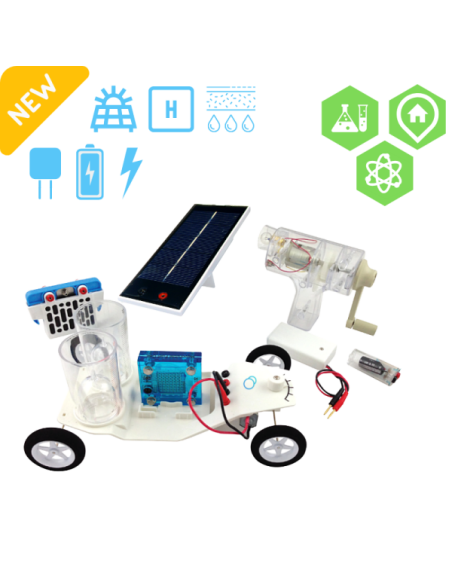
FCJJ-31 Multi Energy Car Science Kit
STEM kit to build five car models and compare hydrogen, salt water, solar, supercapacitor and battery power on one educational chassis.
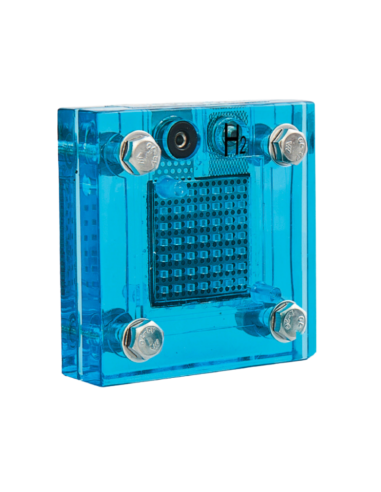
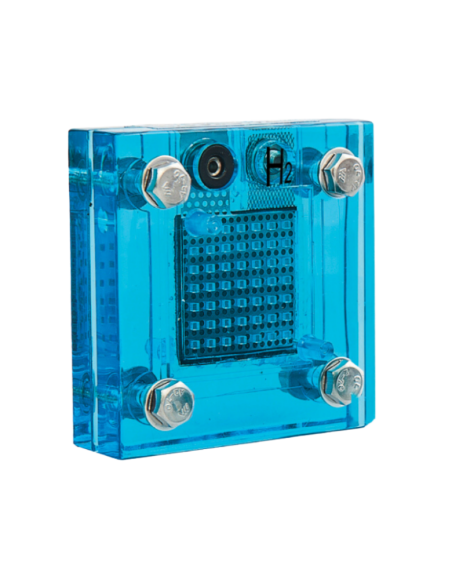
The FCJJ-31 Multi Energy Car Science Kit lets students investigate several electric and renewable propulsion methods with one modular platform. Learners can build up to five configurations on the same chassis and compare performance when the vehicle runs on a reversible hydrogen fuel cell, a salt water fuel cell, solar energy, a hand-cranked supercapacitor or a conventional battery.
This hands-on format makes it easier to study the strengths and weaknesses of each energy source while introducing core ideas in electrochemistry, electric circuits, energy conversion and basic mechanics. The fixed front steering design keeps assembly straightforward and classroom testing consistent.
The kit is also compatible with other Horizon equipment for measurement and data logging, making it suitable for guided demonstrations, STEM projects and structured lab activities.
- Up to five vehicle models from one chassis
- Direct comparison of five energy technologies
- Designed for visual, practical STEM learning
- Compatible with broader Horizon measurement activities
Main teaching content and technical points:
- 12 experiments
- Estimated lesson time: 9 to 17 hours
- Teacher's guide: 139 pages
- Student's guide: 111 pages
- Powered by a reversible hydrogen fuel cell
- Powered by a salt water fuel cell
- Powered by solar energy
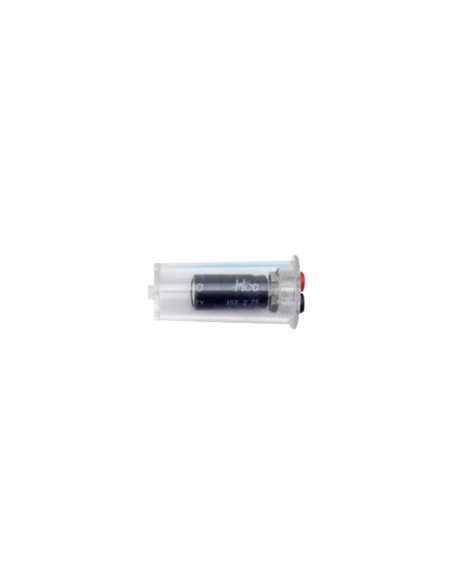
- Powered by a hand-cranked supercapacitor
- Powered by a battery
- Five buildable models on one chassis
- Fixed front steering function
- Compatible with other Horizon kits for measurement and data logging
Curriculum concepts covered:
- Chemistry: electrochemistry, electrolysis, energy, hydrogen generation, reaction rates, redox reactions and solution concentration
- Physics: capacitors, classical mechanics, current and voltage, electric charge, electric circuits, Ohm's law, series and parallel circuits, and electric power
- Earth science: climate change, renewable energy and human impact