


- Home
- Who We Are
- Products
-
Brands
-
Products by Measure
- Vibration Analyzers
- Peristaltic Pumps
- Airflow
- CO Carbon Monoxide
- Geiger counters
- Destiladores
- Spectrophotometry
- Sterilization
- Fluorescence
- GEOTECHNICS
- Soil Moisture
- Leaf area index
- Rain Gauge
- Meteorology
- Water Level
- O2 Oxygen
- pH
- Differential Pressure
- Radiation
- Salinity/Conductivity
- Telemetry
- Air Speed
- Relative Humidity
- Veterinary
- FUEL CELL HARDWARE
- Network Analyzers
- Calibrators
- WATER FLOW
- Color / Colorimeter
- Particle Counters
- Wind Direction
- Spectrometry
- Evapotranspiration
- Photosynthesis
- Cracks in Buildings
- Pipes Inspection
- Quantum Light
- Movement & GPS
- Diesel Level
- Oxígeno Disuelto DO
- Atmospheric Pressure
- Radon
- Sap/Sap Flow
- Temperature
- AIR QUALITY
- Ammonia
- Chlorophyll
- Conductivity in Soil
- Dendrometers
- Electrochemistry
- Spectroradiometry
- Pharmacy & Medicine
- GAS (ANALYZERS)
- Leaf Wetness
- Idc (DC Current)
- KW & KW/H
- PAR Light
- Nitrate
- Occupation and Time
- Particle Meters
- Soil Water Potential
- Pulses
- Flavor/Taste/Acidity
- Sodium
- Turbidity
- VOC
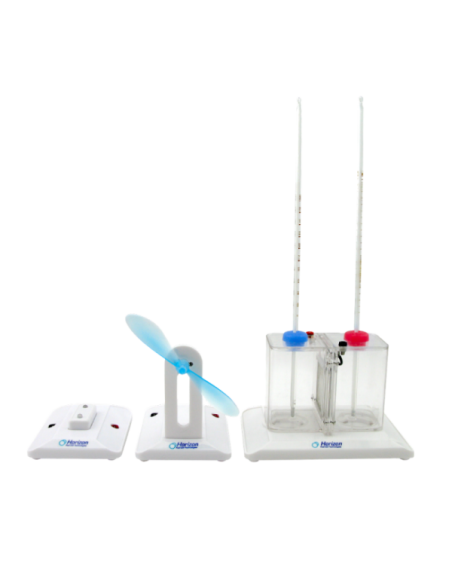
FCJJ-38 - Thermal Power Science Kit
Educational kit for generating electricity from the temperature difference between hot and cold water, with visual output through LEDs, mini turbines and thermal tracking.
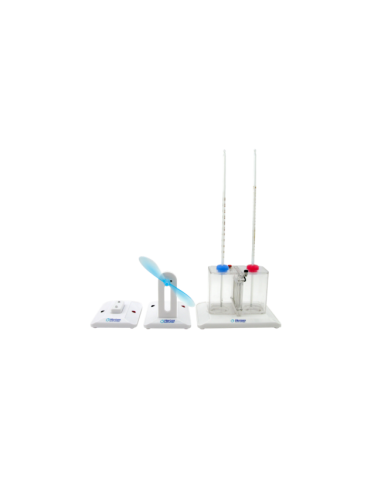
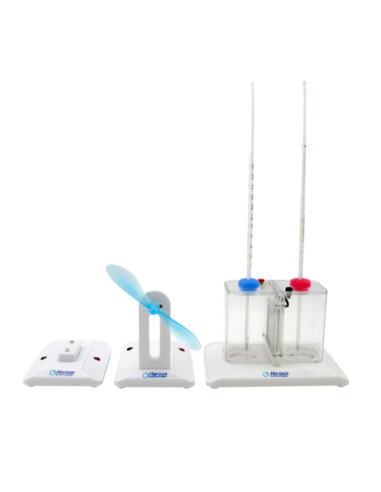
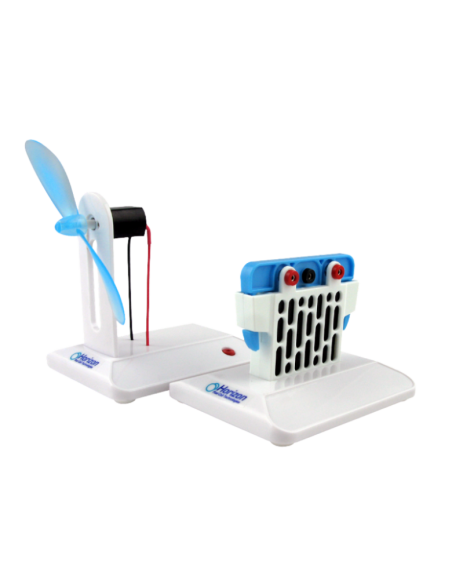
The FCJJ-38 Thermal Power Science Kit allows students to generate electricity using only the temperature difference between hot and cold water and a special conversion cell. As the temperature evens out between the two containers, the power level decreases, making it possible to observe in real time how a thermal gradient affects electrical generation.
LEDs and mini turbines display the variation in generated power, while two thermometers help monitor the temperature of both containers during each activity. It is designed for middle school and high school environments and supports guided learning around thermoelectric energy conversion.
The teaching work covers what a Peltier module is, what the Seebeck effect is, what a semiconductor and a PN junction are, how to classify the dipoles included in the kit, and which central component powers the generator. The kit includes hands-on lab activities, teacher's guides and student's guides for structured classroom use.
Experiments: 6
Lesson time: 2-4 hours
Teacher's guide: 16 pages
Student's guide: 12 pages
Materials provided: hands-on lab activities, teacher's guides and student's guides.
Concepts covered: current/voltage, energy, heat, Ohm's Law, thermal energy and renewable energy.
Curriculum questions and content:
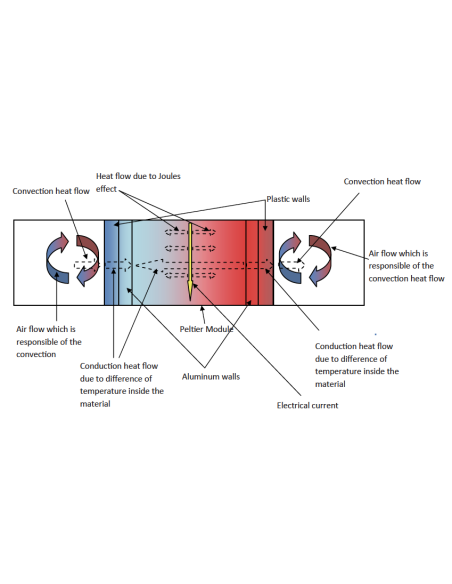
- What is a Peltier module and what is the Seebeck effect? A Peltier module is an electrical component made with semiconductor material. It is used to create heat when electricity is applied. The Seebeck effect describes the appearance of a current at the junction between two materials when crossed by a heat flow.
- What is a dipole and which types exist? A dipole is an electrical component with two terminals. Dipoles can be active, able to generate electrical current, or passive, able to receive current.
- What is a semiconductor and what is a PN junction? A semiconductor is a material with a specific atomic structure that reacts to its environment; when it receives energy, electrons move to the conduction band and can flow through the material. The PN junction is part of this electrical behavior.
- What is the generator's central component and which effect does it use? The central component is a Peltier module and it works through the Seebeck effect, which complements the Peltier effect.