- Home
- Who We Are
- Products
-
Brands
-
Products by Measure
- Vibration Analyzers
- Peristaltic Pumps
- Airflow
- CO Carbon Monoxide
- Geiger counters
- Destiladores
- Spectrophotometry
- Sterilization
- Fluorescence
- GEOTECHNICS
- Soil Moisture
- Leaf area index
- Rain Gauge
- Meteorology
- Water Level
- O2 Oxygen
- pH
- Differential Pressure
- Radiation
- Salinity/Conductivity
- Telemetry
- Air Speed
- Relative Humidity
- Veterinary
- FUEL CELL HARDWARE
- Network Analyzers
- Calibrators
- WATER FLOW
- Color / Colorimeter
- Particle Counters
- Wind Direction
- Spectrometry
- Evapotranspiration
- Photosynthesis
- Cracks in Buildings
- Pipes Inspection
- Quantum Light
- Movement & GPS
- Diesel Level
- Oxígeno Disuelto DO
- Atmospheric Pressure
- Radon
- Sap/Sap Flow
- Temperature
- AIR QUALITY
- Ammonia
- Chlorophyll
- Conductivity in Soil
- Dendrometers
- Electrochemistry
- Spectroradiometry
- Pharmacy & Medicine
- GAS (ANALYZERS)
- Leaf Wetness
- Idc (DC Current)
- KW & KW/H
- PAR Light
- Nitrate
- Occupation and Time
- Particle Meters
- Soil Water Potential
- Pulses
- Flavor/Taste/Acidity
- Sodium
- Turbidity
- VOC
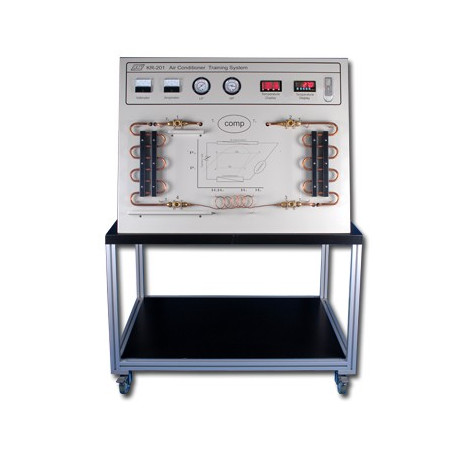
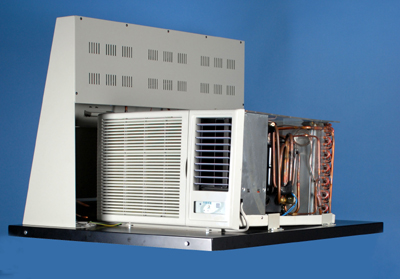
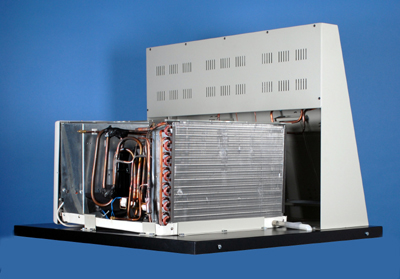
KR-201 Air Conditioner Training System
The main composition of KR-201 is a real window type air conditioner just like in our daily life. What makes it special is that students are able to observe the operation of the internal components and the state of the refrigerant while the air conditioner is running.
From the front panel, there are four refrigerant sight glasses, which provide students an excellent opportunity to observe the state of the refrigerant before and after passing through four major elements Compressor, Condenser, Capillary Tube, and evaporator.
Students can also use built-in gauges/meters to draw the Mollier diagram and so as to understand the performance of this air conditioner. Combining the observation of refrigerant state during different phase of the refrigeration cycle, KR-201 helps students to understand the operating principle of the window type air conditioner easier and faster.
-
The operation of the system is based on a real window-type air conditioner behind the front panel.
-
The metal case of the air conditioner is replaced by plastic acrylic so that students can observe its internal structure even when it is operating.
-
Major components including condenser, evaporator and capillary tube of the air conditioner are extended to the front panel and covered by plastic acrylic to fit experimental needs.
-
Provide 4 sight glasses at front panel to observe the refrigerant status before and after passing through compressor, condenser, evaporator, and capillary tube.
-
Provide voltmeter and ammeter at front panel to monitor instant system power.
-
Provide high and low pressure gauge at front panel to monitor instant inlet/outlet pressure of the compressor.
-
Provide a 6-channel temperature meter located at front panel to instantly display different refrigerant temperature before and after passing through compressor, condenser, evaporator, and capillary tube.
-
Provide a temperature meter located at the front panel to display the temperature from a moveable sensor.
-
A Mollier Chart is clearly printed on the front panel for quick
1. Characteristic of window type air conditioner
2. Measuring and collecting experimental data
3. Drawing Mollier Chart
4. Application of Psychrometric Chart
5. Calculating system performance
- Category
- Air Conditioning